
Arrest Warrants in Monroe County
Alabama gives magistrates two paths to a warrant. Under Alabama Rule 3.1, a warrant or summons can issue after an indictment or on probable cause found through the complaint process. Rule 3.2 then sets the paperwork: the warrant must name or describe the defendant, state the offense, command an arrest, and direct the person to appear before the issuing officer. Monroe County follows a simple filing sequence. A complainant reports the incident to the sheriff or municipal police, brings the report to the warrant office, and swears to a deposition. A magistrate weighs probable cause from there. Filing itself costs nothing. The local page does warn that a later requested dismissal may bring costs.
Monroe County Arrest Warrant Cause
Where you file depends on the offense. Felony warrant work follows the county route anywhere in Monroe County. Misdemeanors split along a boundary: matters outside Monroeville and Excel go one way, cases inside city jurisdiction another. That line decides whether the county magistrate or a municipal court is your first records contact. The official warrant page also keeps two tracks apart. A complainant files through one set of steps. Someone checking a warrant in his or her own name is told to appear in person at the sheriff. One route cannot stand in for the other.
What a Monroe County Arrest Warrant Contains
The official CR-58 form shows the field structure without exposing anyone's private record. A sample label such as CR-58 SAMPLE is illustration only. The signature on a Monroe County warrant identifies the issuing authority; it does not mean the clerk decided probable cause.
| Warrant and case numbers | Court identifiers |
|---|---|
| Person described | Name or identifying description |
| Offense | Alleged offense supporting arrest |
| Court and county | Issuing venue and caption |
| Release option | PR, appearance bond, or secured terms if stated |
| Execution return | How and when an officer served it |
How Monroe County Arrest Warrants Are Served
Alabama Rule 3.3 lets law enforcement officers execute warrants anywhere in the state. The return must be endorsed and sent to the clerk. So a sheriff's deputy, a municipal officer, or another authorized officer may serve a Monroe County order. The issuing court and the serving agency need not match. After service, custody, booking, bond, and first appearance all turn on the warrant and the court involved. Monroe County publishes no surrender-hour page, bond-window schedule, or promise of immediate release.
Monroe County Arrest Warrant Channels
Suspect a county warrant? Call the sheriff at 251-575-2963. The official direction is an in-person visit at 65 North Alabama Avenue, Room 136, so confirm logistics before you go. Circuit or District records route to the Circuit Clerk in Room 220, 251-743-2283. Monroeville city cases go to Municipal Court at 251-575-2081. Excel's 251-765-2558 listing is a routing lead only; the town posts no dedicated court page. ALEA's fugitive portal is curated, not a complete Monroe County warrant search.
Key point: Monroe County says an arrest warrant is not public until served, so an empty public search does not establish clearance.
Arrest Warrant vs Summons vs Bench Warrant
Each instrument demands something different. An arrest warrant commands custody after indictment or probable cause. A summons commands appearance without an immediate arrest. A Monroe County bench warrant usually follows a missed duty in an existing case. Whatever the paperwork says controls the response.
| Feature | Arrest Warrant | Summons | Bench Warrant |
|---|---|---|---|
| What it orders | Arrest | Appearance | Arrest and return |
| Basis | Indictment or probable cause | Complaint process | Missed duty |
| Issuer | Judge or magistrate | Authorized court officer | Issuing court |
| Response | Status, surrender, bond | Appear as directed | Recall or appearance |
What to Do If There's a Warrant for You
Start by identifying the issuing court. Then ask about service, surrender, bond, and appearance. An attorney can give case-specific advice and coordinate a Monroe County response; a clerk supplies records and procedure but cannot tell you which legal choice to make.
Important: Confirm Monroe County surrender logistics before appearing; official sources provide no walk-in hours or guaranteed release terms.
Monroe County Arrest Warrant Bonds
Rule 7.1 lays out the release options: personal recognizance, appearance bond, secured bond, cash or certified funds, and surety. A release box on CR-58 may state one option. That box does not guarantee the same outcome in every Monroe County case. The detention number, 251-575-2635, is only a contact lead. The county publishes no bond-hours schedule or list of accepted payment methods. So ask the current amount, the bond type, the accepted method, and where to post it. A Rule 7.2 range is not a case-specific bond.
Monroe County Arrest Warrant Court
The successful project capture comes from the official Monroe County court page.
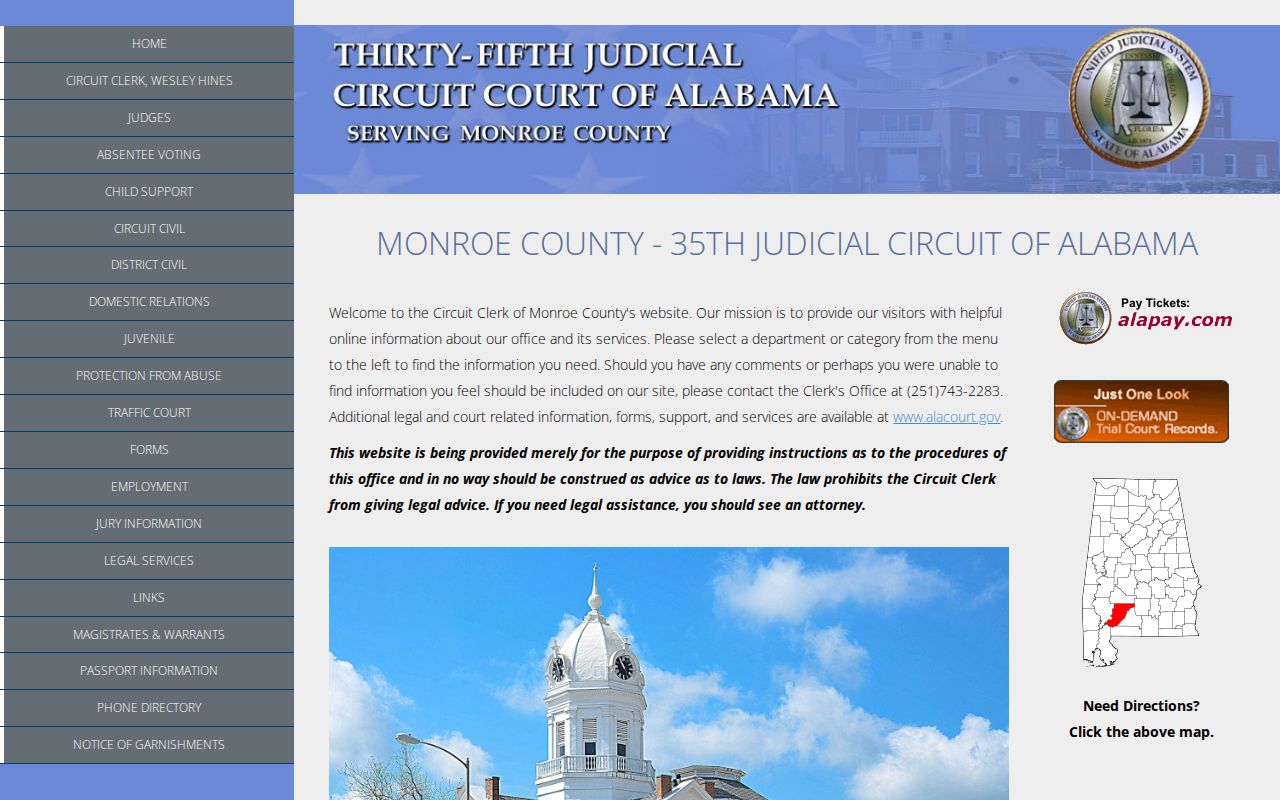
The Monroe County court page names both the courthouse and the clerk, and that matters for a warrant check. The clerk's divisions cover Criminal, Traffic, Juvenile, Civil, Domestic, Child Support, and Warrants, so staff can point you to the right file when you have a case number but not the division. The Circuit Clerk keeps the records and runs the office business; a judge, not the clerk, decides probable cause and what happens in your case. Court hours run 8:00 a.m. to 4:00 p.m. on weekdays. That schedule covers the clerk only, not sheriff warrant service or detention bond windows, so confirm each office before you travel. Bring photo identification and any court papers you were told to carry. Keep sensitive details out of unverified email or commercial forms. Once the court side is clear, the sheriff in Monroe County is the office to ask about service or surrender, when that is the official next step.
Monroe County Arrest Warrant Service Status
An unserved arrest warrant in Monroe County is not a public record. That comes straight from the Monroe Magistrates page. It matters more than any online-access promise. Skip sweeping requests for unserved names. Anyone checking a suspected Monroe County warrant of their own should use the sheriff's in-person route or call the issuing court directly. Once served, the picture changes. The file may hold the warrant itself, the officer's return, the charge, a bond record, an appearance, and later case action. Even then, access has limits. A sealed case can stay closed. Investigative material may be withheld. Alabama Code §12-15-134 also bars public access to law enforcement records about a child. For copies, the Monroe County Circuit Clerk says District and Circuit records are electronically imaged and points to Just One Look for much trial-court data, though fees apply and no individual warrant image is promised to be online or current. Make any request specific. Give the court, the case or warrant number if you have it, the date range, and the format you want. If part of a file is restricted, ask for the permissible portion that remains open. Monroe County publishes no local warrant request form. No set copy fee is posted either. For the current process, call the clerk's office or the sheriff.
Monroe County Arrest Warrant Jurisdiction
Where a Monroe County case lands depends on the charge, not on which officer wrote the first report. A city officer can open a felony file, yet the case still travels the state-court route. Rule 3.3's committee material allows a municipal judge to issue a felony warrant returnable to Circuit or District Court. That trips up a lot of people. A city police role does not make the municipal clerk the keeper of the final court record. For county misdemeanors outside Monroeville and Excel, the magistrate process through the local court applies, while misdemeanors inside those two cities start at the municipal layer. Traffic citations follow the court printed on the ticket plus the Alabama Traffic Service Center. The Monroe County Sheriff can execute warrants and help confirm county status. Still, that office is no substitute for the clerk of the issuing court. One more wrinkle deserves mention. If the paperwork names a federal court, no Monroe County office can establish federal warrant status. Federal criminal matters here belong to the Southern District of Alabama. PACER is an official docket service rather than a warrant list, and even docket access may not surface a sealed federal process.